

Two videos you may be interested in from my recent trip to Dalian: a panel discussion I did on “Resisting Autarky”, and a free-wheeling conversation I had with Nikhil Kamath and Zhu Ning.
According to the Federal Reserve’s latest policy statement, “productivity growth and capital investment are strong”. At the press conference following the latest meeting, Fed boss Kevin Warsh elaborated that the U.S. economy was in “a race” between efficiency gains, which allow workers to produce more goods and services from the same volume of inputs, and business spending, which has been driving up the prices of everything from land to laptops. Both, of course, are being driven by AI. The outcome of this race, according to Warsh, will determine what happens to inflation, and, by extension, the appropriate level of interest rates.
There is no doubt that American companies have been spending hand-over-fist on equipment for data centers, lately to the chagrin of shareholders and creditors. Productivity, however, is much harder to measure. Output per hour is estimated by dividing three separate data series—nominal spending and incomes, prices, and hours worked—all of which are prone to measurement error and revision.
That said, the data we have so far from the Bureau of Economic Analysis (BEA) and the Bureau of Labor Statistics (BLS) imply that American workers produced about 2% more goods and services per hour worked in 2026Q2 than in 20252. That would be only slightly above the longer-term trend of productivity growth from 2004Q1-2019Q4, which also happened to be the same as the trend growth rate of productivity from 1984Q1-1996Q4.1 (Things looked slightly better a few quarters ago.) So far, the excitement about productivity is more about expectations than what is currently visible in the hard data.
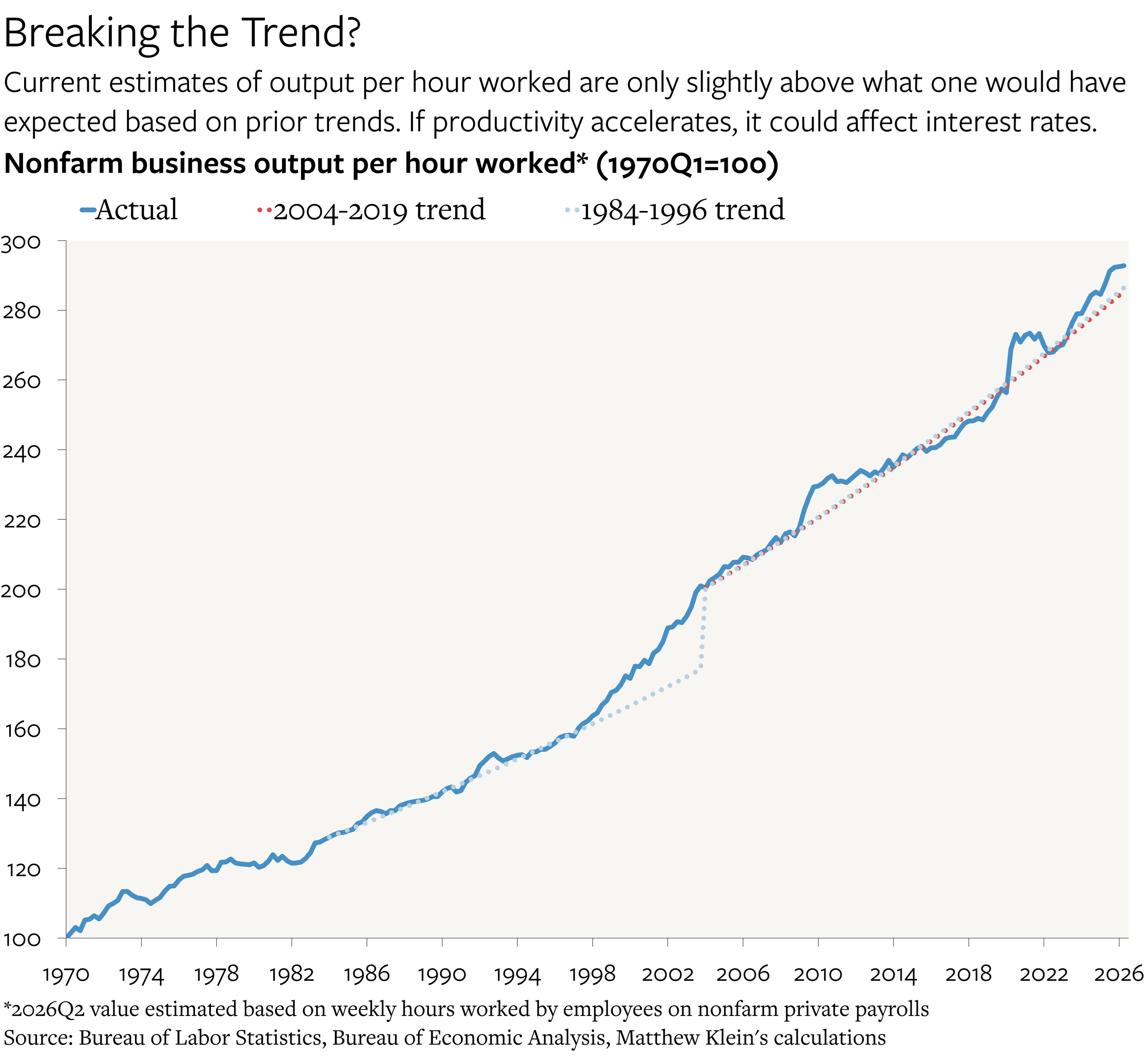
But even if productivity growth were poised to accelerate, and even if that coincided with an “immaculate” disinflation, which so far seems unlikely, the implications for interest rates are far from obvious. The lesson of the 1990s, to the extent that there is one, is that real rates might need to increase by more than any drop in inflation compensation, depending on what new technologies do to the prospective returns on investments and the resulting demand for capital.
The danger is that policymakers inadvertantly lean into a boom, thereby turning it into a bubble that then bursts violently. The same animal spirits and financial leverage that inflate activity on the way up are incredibly destructive on the way down. It would be far better for policymakers to focus on smoothing out the cycle—which is, after all, their job—by stretching out the investment boom over time. That could require higher interest rates even if inflation somehow manages to decelerate to the Fed’s alleged 2% yearly target.
While writing this note, I realized that I needed to split it into two parts. This one focuses on the U.S. productivity data and why new software has not yet had much of an impact on standard measures of technological progress. The second part will focus on the implications for interest rates and monetary policy, with a deeper look at the experience of late 1990s and early 2000s.
Is Productivity Accelerating or Slowing?
While the headline measure of output/hour had been rising relatively briskly, there are reasons to be skeptical about how sustainable this is, much less whether it is attributable to genuine innovation.
Output/hour can rise for many reasons. Workers can get more experience and education, they can get equipped with more and better machines, they can benefit from cheaper input prices—someone on the other side of the world starts pumping more oil, for example—and they can push themselves to work harder in ways that might not be immediately evident in the data. While all of these changes can be good for growth, none of them make workers more efficient, because they all involve using more inputs to generate more outputs.
This is why economists at the Federal Reserve Bank of San Francisco estimate the contribution of underlying improvements in technology and efficiency, which they call “utilization-adjusted total factor productivity” (TFP), by stripping out the growth impact of changes in hours worked, the capital stock, “labor quality”, and the state of the business cycle. (Those who want the details should read the technical paper by John Fernald explaining the methodology.)
The chart below shows how all of these factors have contributed to quarterly changes in “real business output”, which is close to, but conceptually distinct from, both Gross Domestic Product (GDP) and the measure (found in NIPA table 1.3.3.) used by the BLS in their official series on productivity.2