

Borrowing costs are up everywhere. And France—thanks to its dysfunctional domestic conditions and its membership of the euro area—is getting hit the hardest.
In the years immediately before the pandemic, long-term yields on government debts in Japan and “core” Europe were roughly zero or negative before inflation, about 1% in the U.K., ~1.5% in Czechia, about 2% in Australia, Canada, the U.S., and Korea, and about 3% in Poland. As of this writing, longer-term yields are now about 3% in Japan, ~3.5% in Germany and Sweden, 4% in Canada and Spain, close to 5% in France and Korea, and a bit over 5% in Australia, the U.S., U.K., Czechia, and Poland. As far as I can tell, the only rich countries that have largely missed out on the yield reset have been Switzerland, Singapore, Taiwan, and Greece (sort of), albeit for very different reasons. In general, long-term yields in the rich countries are about 2-3 percentage points higher than they were on average in 2017-2019.
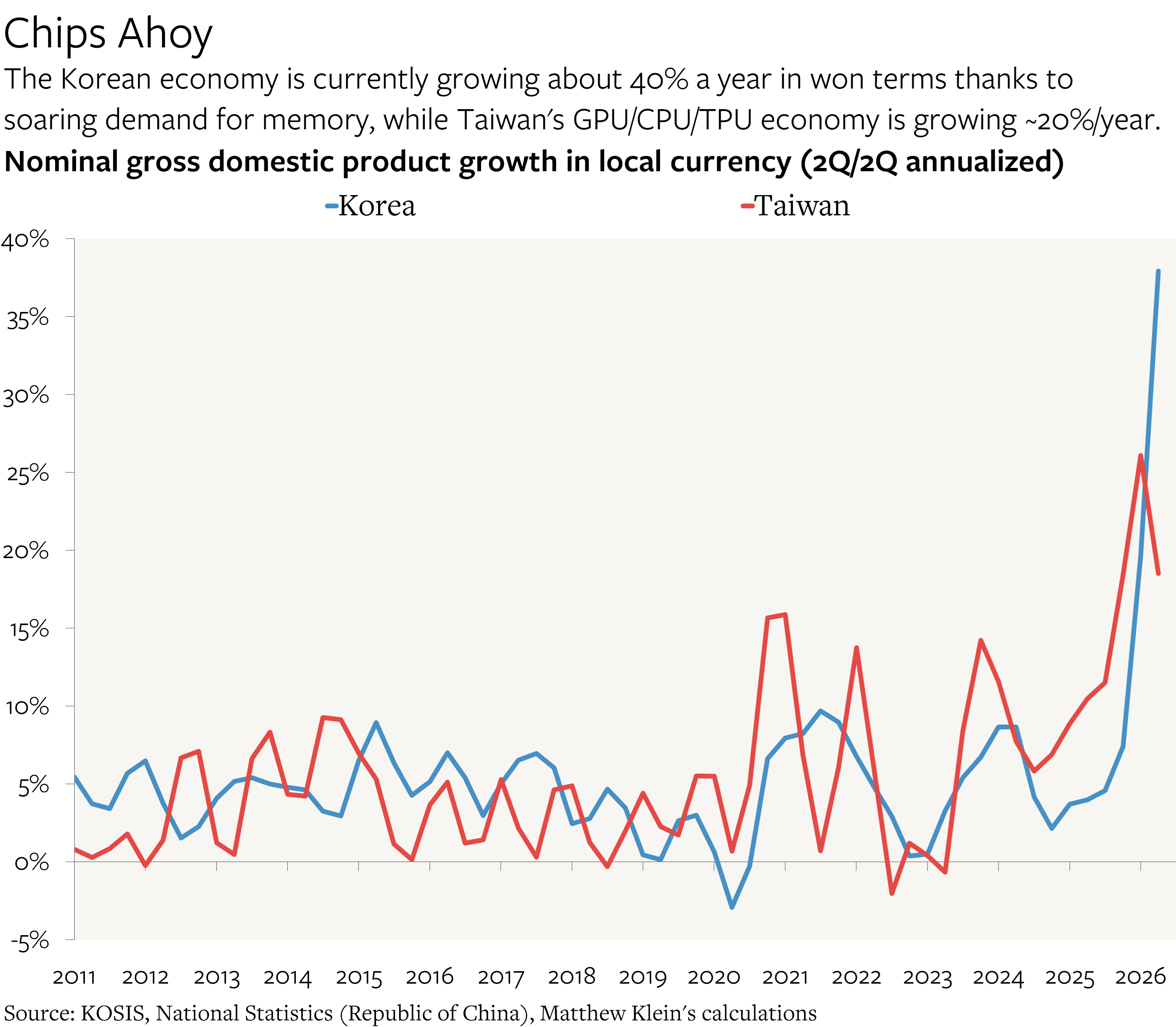
Whether this is a problem depends on where you are. A simple average across rich countries shows that the most recent 12-month nominal income growth rates are also 2pp faster than the 2017Q1-2019Q4 annualized average. But that average conceals considerable variation across countries. For many places, such as the U.S., Canada, Japan, Portugal, and Spain, there has been a one-for-one link between the uptick in yields and the change in growth rates. In a few cases, such as Taiwan, Korea, and Greece, yields have gone up by much less than one might have guessed based on how much growth has accelerated. It may not last, but the Taiwanese economy is currently growing by about 20% a year in local currency terms while the Korean economy is growing at 40% (!) thanks to soaring export earnings.
On the opposite extreme is France.
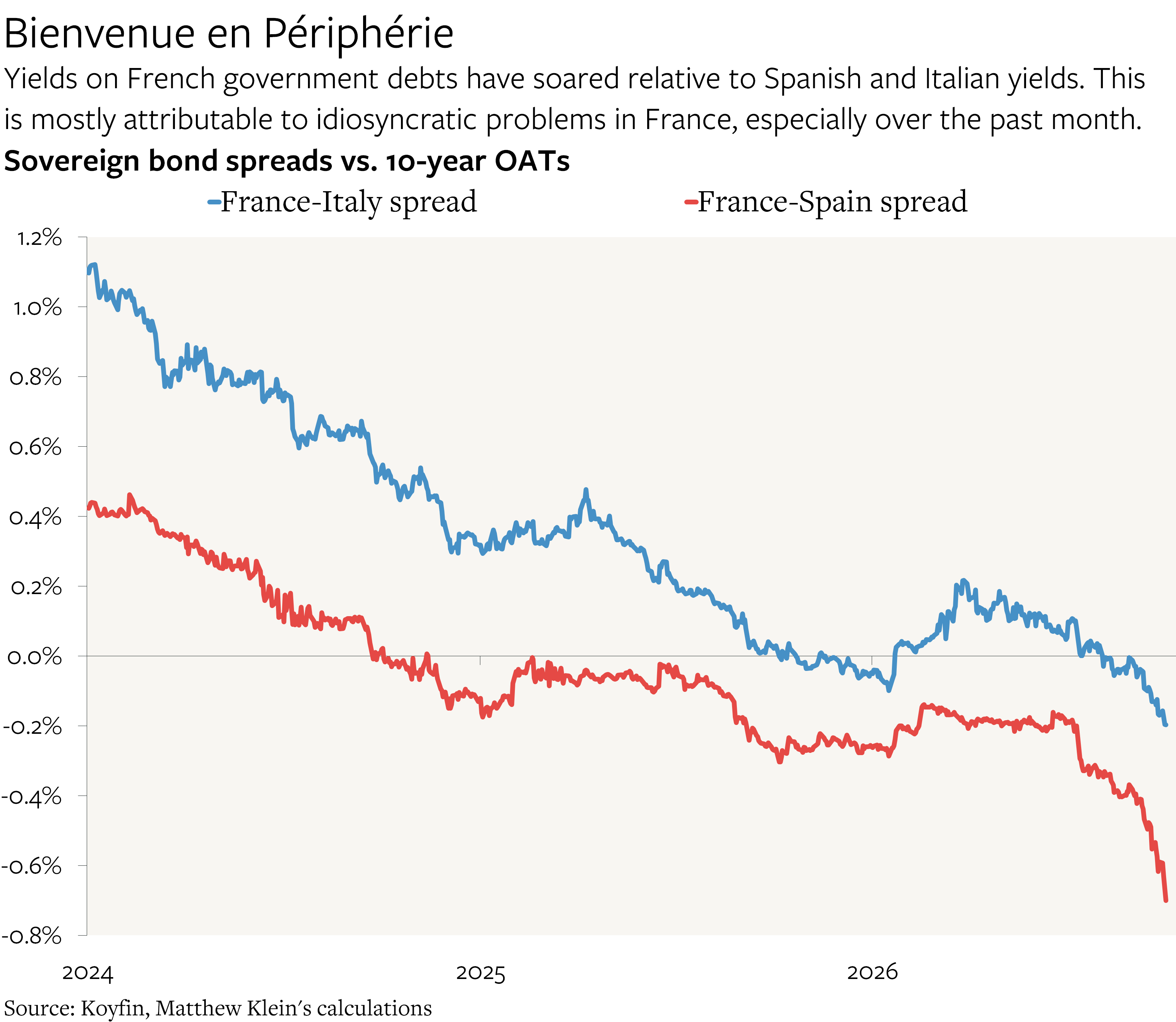
Yields on French government bonds (OATs) now exceed the yields on their Spanish, Italian (BTPs), Greek (GGBs), and Portuguese equivalents. For veterans of the euro crisis, this is a remarkable turn of events. As recently as 2024, yields on 10-year BTPs were about 1.1 percentage points higher than on 10-year OATs. But as of this writing, 10-year OATs now yield about 0.2pp more than the equivalent BTPs. The resulting 1.3pp shift in the spread has occurred in almost a straight line. While some of that move was a function of improving conditions in Italy in 2024, it mostly reflects problems in France, especially over the past few months. For example, the spread between Belgian and Italian yields has been essentially unchanged over the past year.
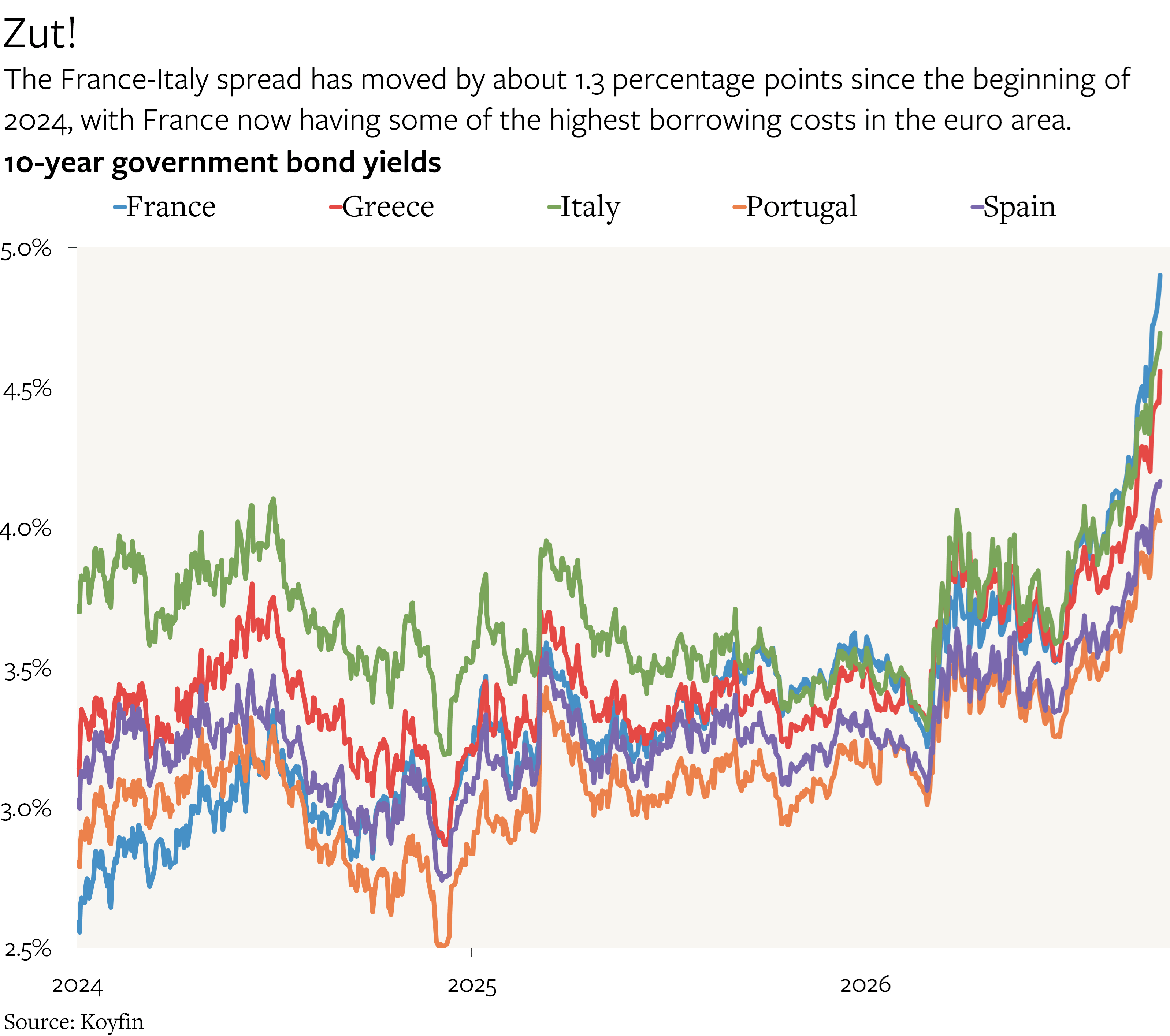
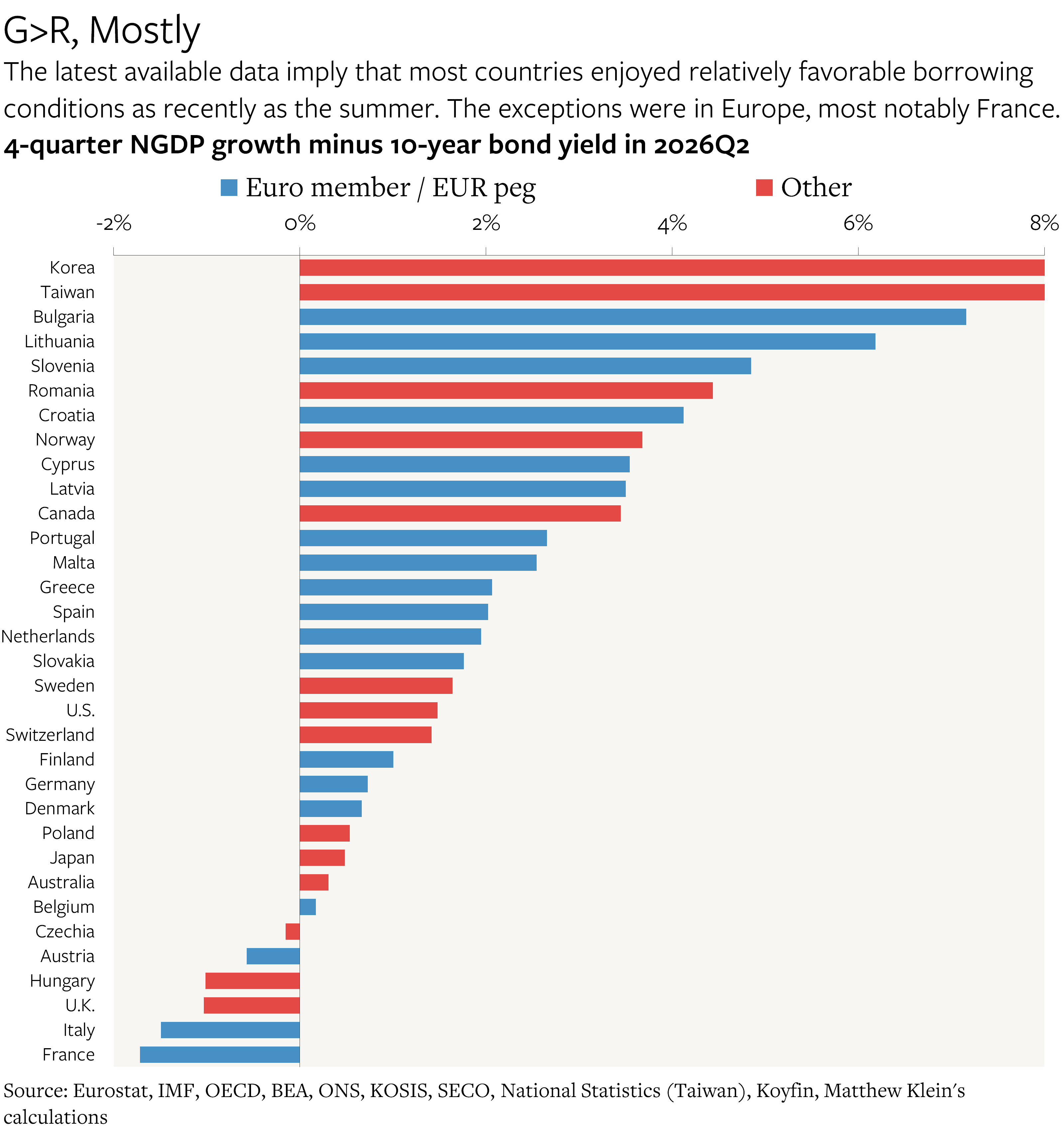
The problem for France is that its bond yields are surging even as its nominal income growth has slowed relative to the 2017-2019 pace, to the point that, almost uniquely among rich countries, borrowing costs there now substantially exceed growth rates. In fact, the spread between French sovereign borrowing costs and French growth rates is now the most unfavorable anywhere in the rich world.1 The French economy was not quite growing by 2% a year in euro terms as of 2026Q2, which was even worse than the anemic 3% yearly average nominal growth rate recorded in 2017Q1-2019Q4. As of 2026Q2, France’s cost of borrowing was therefore about 2pp higher than its income growth rate. (At current yields, the penalty is more like 3pp.) By contrast, Spanish and Greek bond yields are still about 2pp lower than their income growth rates.
Abusing “Le Privilège Exorbitant”
At one level, the problem is obvious: