

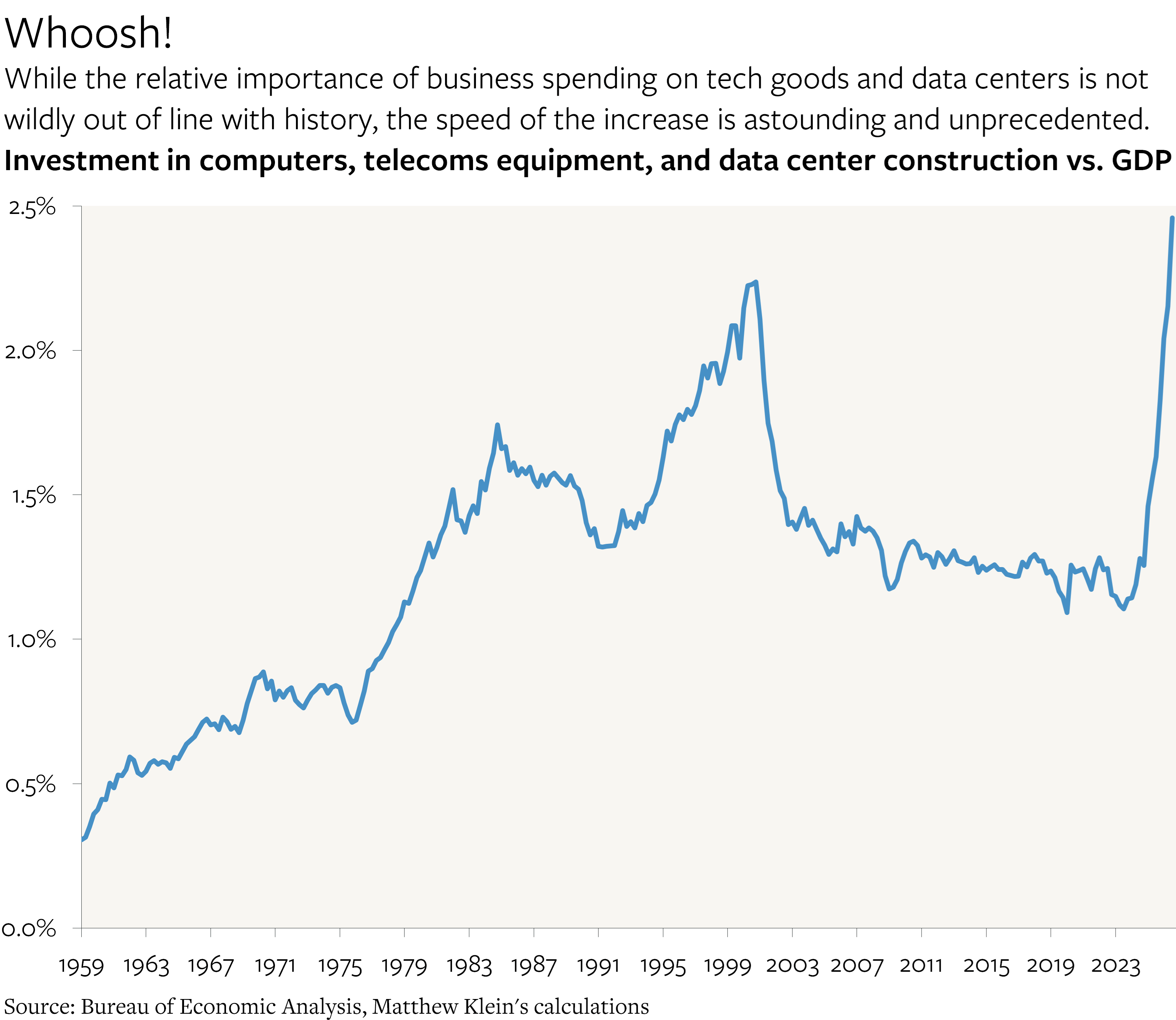
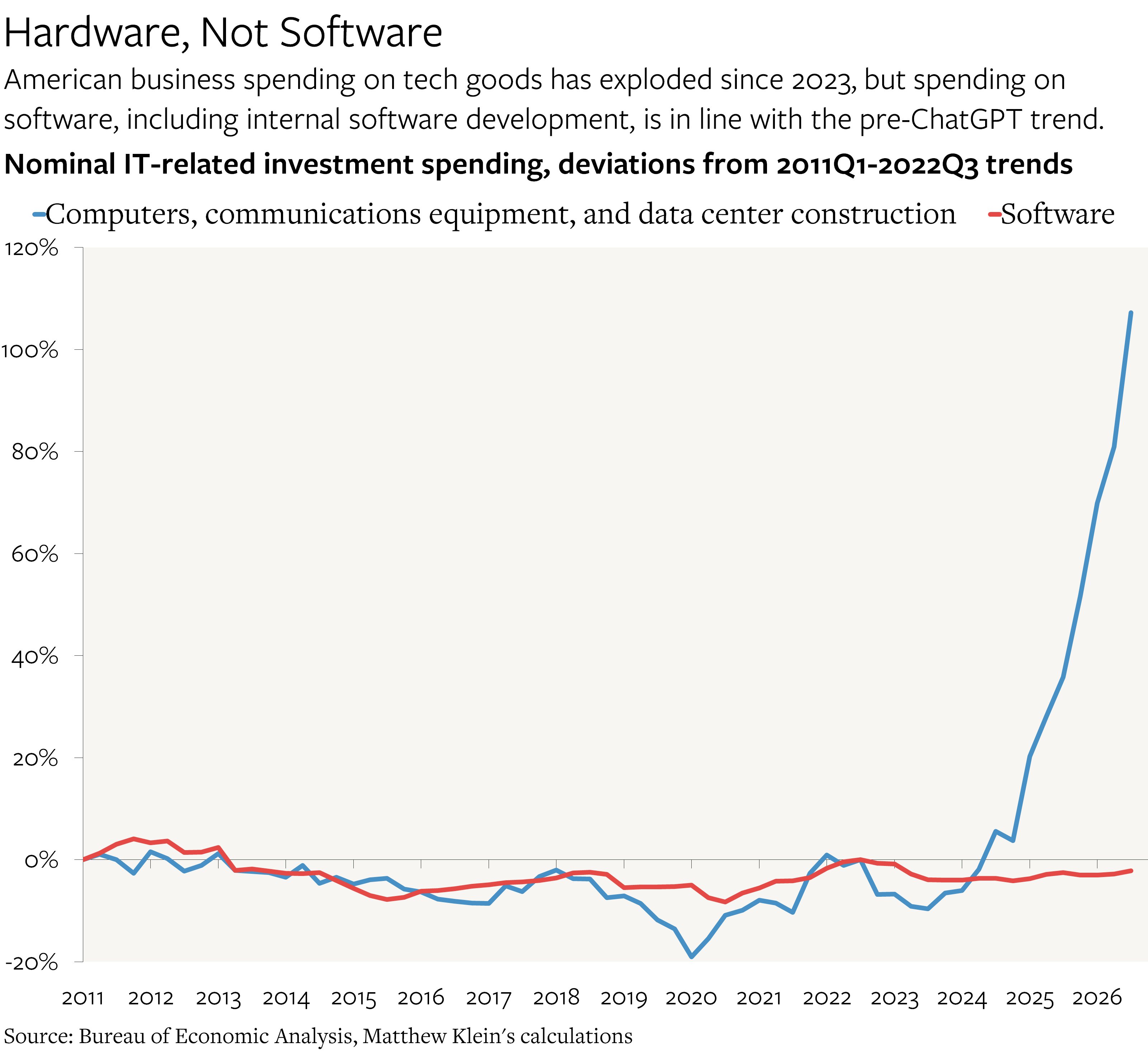
The U.S. dollar value of business spending on computers, on telecoms equipment, and on the construction of data center shells is currently running more than 100% above the stable pre-ChatGPT trend. As of 2026Q3, this investment was equivalent to 2.5% of the dollar value of all the goods and services produced in the U.S., roughly double the stable 2009-2024 average of 1.3%. The total amount of spending is impressive, but what really stands out is the sheer speed of the increase just since the end of 2024. (Intriguingly, the same cannot be said for business investment in software, which has continued to grow at the same pace as the pre-ChatGPT trend.)
What follows is an update on the macro level impact of this investment boom.
The Rise and Rise of the Hyperscalers
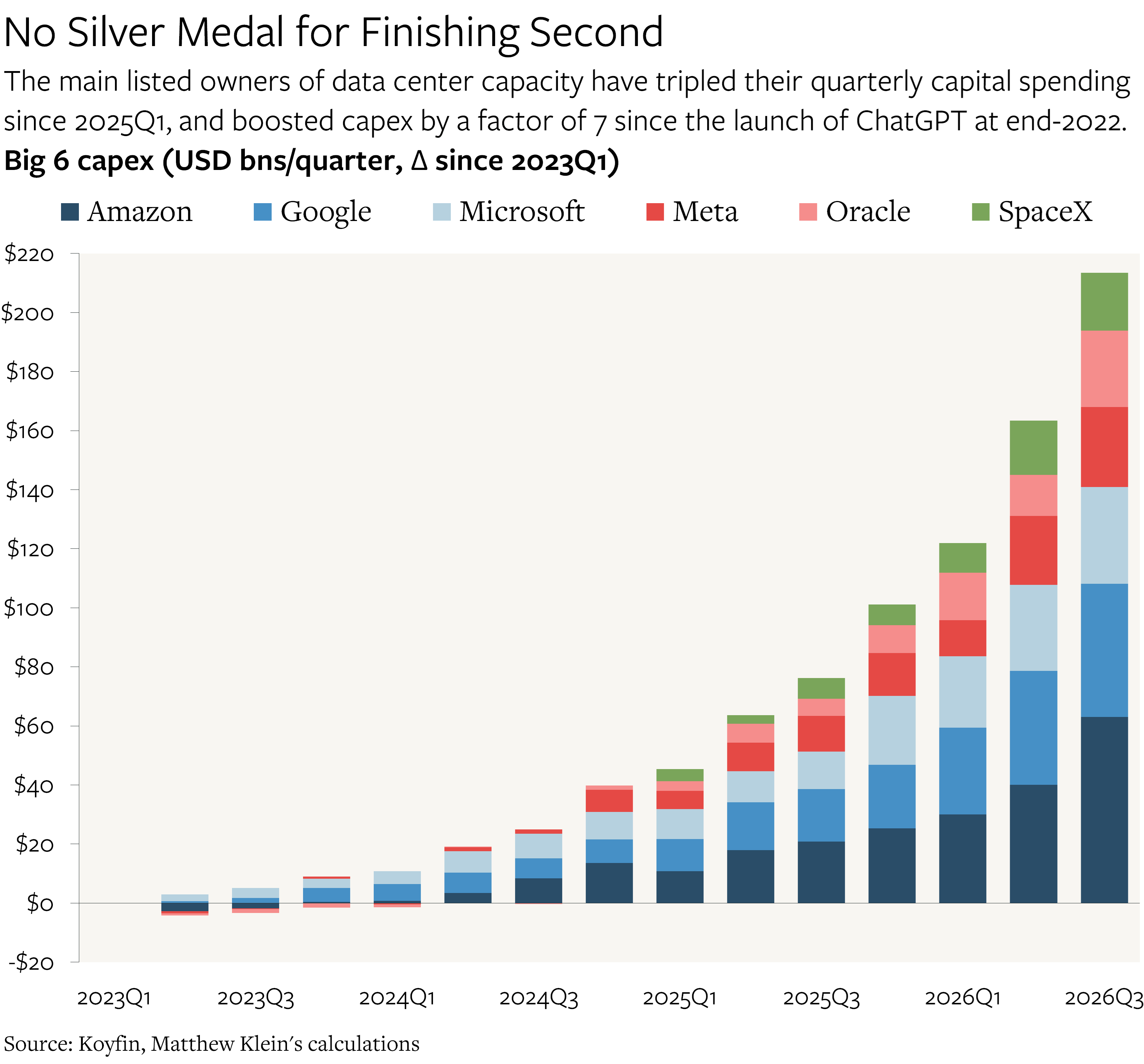
Much of this additional spending is currently attributable to six listed companies with a combined market capitalization, as of this writing, of roughly $13.6 trillion: Amazon, Google, Meta, Microsoft, Oracle, and SpaceX. Since the launch of ChatGPT at the end of 2022, these six listed “hyperscalers” have increased their quarterly capex by a factor of 7. Their reported investment spending has surged by a factor of 3 just since the start of 2025, and as of 2026Q3, it was running at an annualized rate of $1 trillion. Of these six, Amazon and Oracle have chosen to focus on selling their computing capacity to others, while the rest are also investing in proprietary “compute” to support their internal AI labs.
It is worth pointing out that the six publicly-listed hyperscalers are not the full set, just the only ones for which we currently have roughly comparable data via audited financial statements. There are two other hyperscalers that are not (yet) publicly-listed: Anthropic and OpenAI. Unlike the other six, Anthropic and OpenAI are net consumers of “compute”, rather than net suppliers, but they are still poised to invest heavily in generating additional supply. They will likely become a significant source of direct demand for the goods installed in data centers, in addition to their existing indirect demand via renting compute from the other six.
Anthropic’s S-1 notes, in bold italicized font, that “we are pursuing initiatives to develop our own data center infrastructure, which involves significant capital commitments”. As they explain in more detail:
To help reduce our dependence on CSPs [cloud-service providers such as Amazon, Google, and Microsoft], address constraints on available compute, and secure access to compute at the scale necessary for frontier model development, we are pursuing initiatives to develop our own dedicated on-premise data center infrastructure. These efforts include long-term leases and partnerships with third-party partners to procure the underlying real estate, power, and data center facilities while we lease capacity in those facilities and contract with specialized third-party operators for ongoing facility management. We also procure certain compute and infrastructure equipment directly and operate it in dedicated data center facilities leased and operated on our behalf, to our specification…In addition, to meet the substantial energy demands of large-scale AI workloads, we have entered into, and may in the future enter into, arrangements involving dedicated power generation assets and/or the development, operation, or control of power stations or other energy infrastructure…Our existing commitments are substantial, and we expect our capital expenditures to increase significantly as we continue to expand our compute and infrastructure build-out.
When Unlimited Demand Meets Finite Supply
All of this extra spending has been flowing mostly to the handful of companies that capture much of the value in manufacturing the equipment that goes inside and connects the server racks that fill the data centers: Broadcom, Micron, Nvidia, Samsung Electronics, SK Hynix, and TSMC.1