

It is perhaps fitting that the official consumer and producer inflation numbers for June, which were flattered by the 9.5% decline in the prices of consumer energy goods, were published just after the U.S. officially restarted its war with Iran. To the extent that the renewed fighting further disrupts the flow of critical commodities, the prices of those goods will have to rise by enough (relative to incomes) to force consumption and supply into balance.1 As of this writing, front-month Brent crude oil futures cost about $90/barrel, up from about $70/barrel at the beginning of July.
Policymakers could force down the prices of unaffected goods and services by enough to keep the overall price level in line with their alleged 2% yearly inflation target. But the costs of doing so—business failures, credit losses, and, ultimately, unemployment—would likely be too high for most central bankers to tolerate. This is why, even though supply disruptions do not have to be associated with faster inflation, faster inflation tends to be the best response compared to the alternatives. It is therefore reasonable to expect that prices will rise faster in the months ahead than they did in June.
Nevertheless, the June numbers are interesting to the extent that they provide some insight into what inflation might end up looking like if the situation with Hormuz ever gets resolved. At first glance, they are extremely encouraging. Even excluding the drop in the prices of energy goods and services, the Consumer Price Index (CPI) was essentially the same in June as in May on a seasonally-adjusted basis. That is the slowest pace of one-month inflation since January 2021. While it would be tempting to conclude that the long-awaited disinflation has arrived, the likelier explanation is that this is a fluke. There are four basic reasons for skepticism:
Since the pandemic, there has been a recurring seasonal pattern where price increases have been fastest in the first few months of the year, only for those spikes to be followed by temporary—and misleading—slowdowns in inflation every summer in 2023, 2024, and 2025 (and 2022, to a lesser extent).
Inflation ex-energy was depressed by extremely large and unusual price declines in a handful of odd categories (motor vehicle insurance, phone bills, and jewelry), while categories that have tended to be better barometers of underying inflationary trends showed no meaningful deceleration.
Data from the Producer Price Index (PPI) suggests that input costs, particularly for business services, are still rising rapidly.
Most importantly, wage growth and the job market continue to be roughly consistent with underlying inflation being about 1-1.5pp faster (annualized) than pre-pandemic.
Residual Seasonality Strikes Again?
It is apparently easy to forget, but starting in 2023, U.S. inflation numbers have consistently come in hot in the first few months of each calendar year, slowed sharply in the middle months, and then re-accelerated in the back half of each calendar year. This pattern has persisted through 2026, and is particularly obvious if the most volatile and idiosyncratic items are removed. The chart below is based on the Federal Reserve Bank of Atlanta’s measure of inflation based on components where prices normally change slowly, but the picture looks similar using other types of core/trimmed measures.
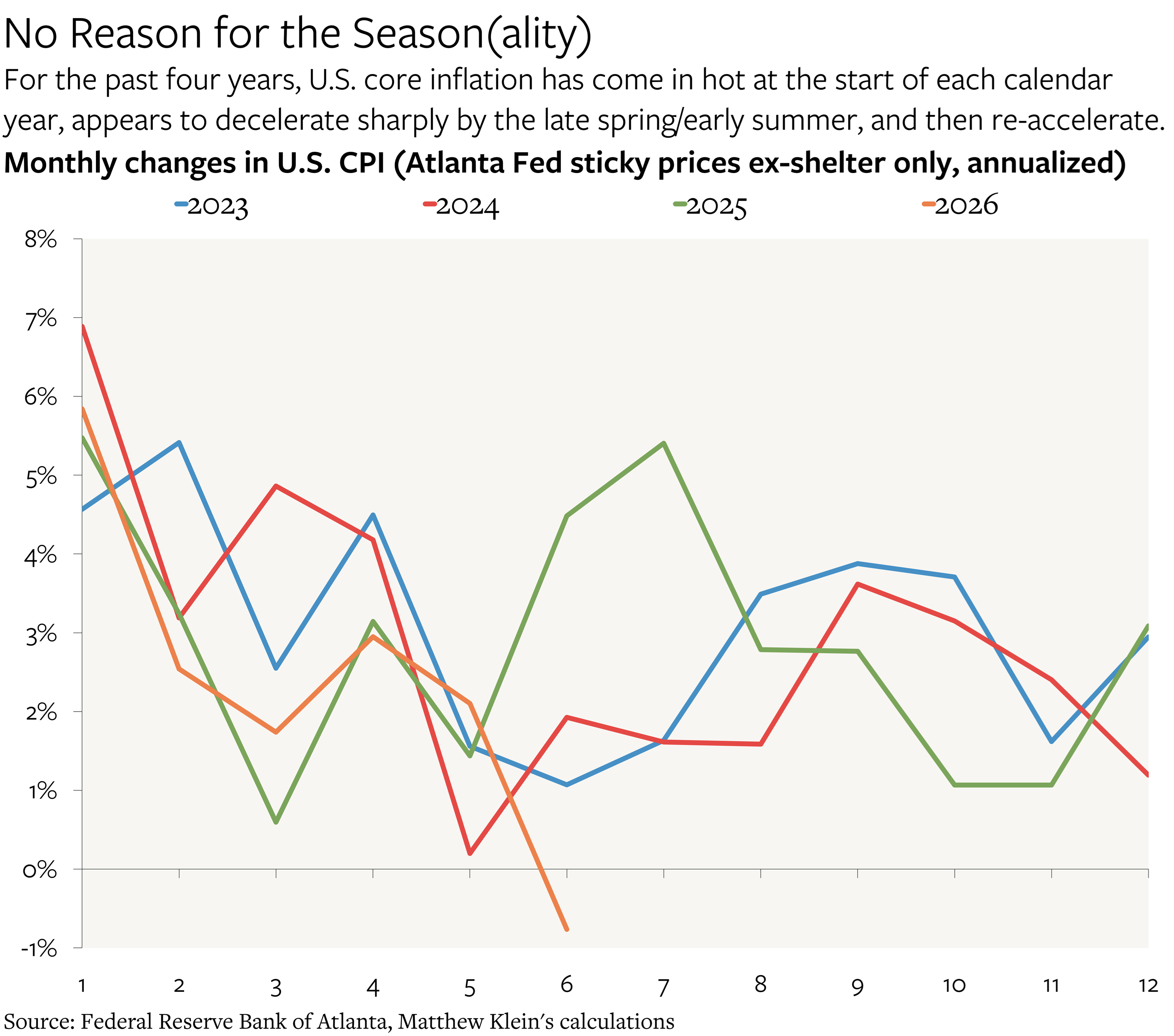
It is not clear why this has kept happening, but there are at least two plausible complementary explanations. First, the seasonal-adjustment algorithms might have been so badly affected by the pandemic and post-pandemic price spikes that they are failing to filter out “normal” patterns across the calendar year during less extreme periods. It is also possible that businesses have changed when and how they adjust their prices since the pandemic, deliberately front-loading price hikes in ways that have yet to be captured by the seasonal adjustment algorithms.
Either way, underlying inflation in 2026 so far looks about the same as it did in prior years, depending on the precise measure chosen.2 While it is certainly possible that the recent pattern will break and that monthly inflation will not re-accelerate from here, investors should be prepared for the possibility that the 2023-2025 trajectory could repeat in 2026.
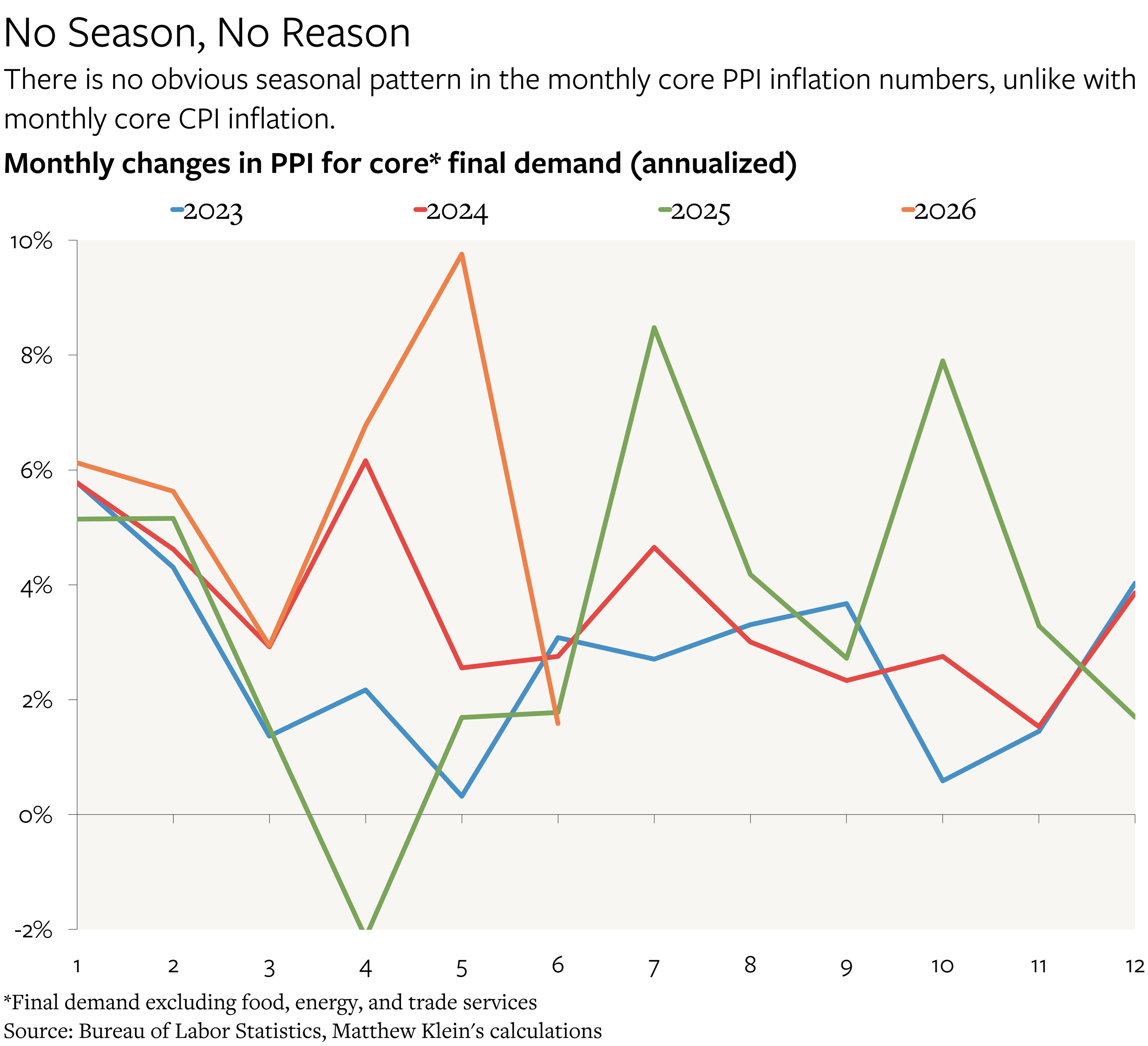
Interestingly, this seasonal pattern is not evident when looking at the prices charged by U.S. businesses, whether to each other, to domestic consumers, to foreigners, or to the government, according to the various measures included in the PPI. Moreover, there are no signs of any slowing in the PPI numbers from 2023H1 through 2026H1.
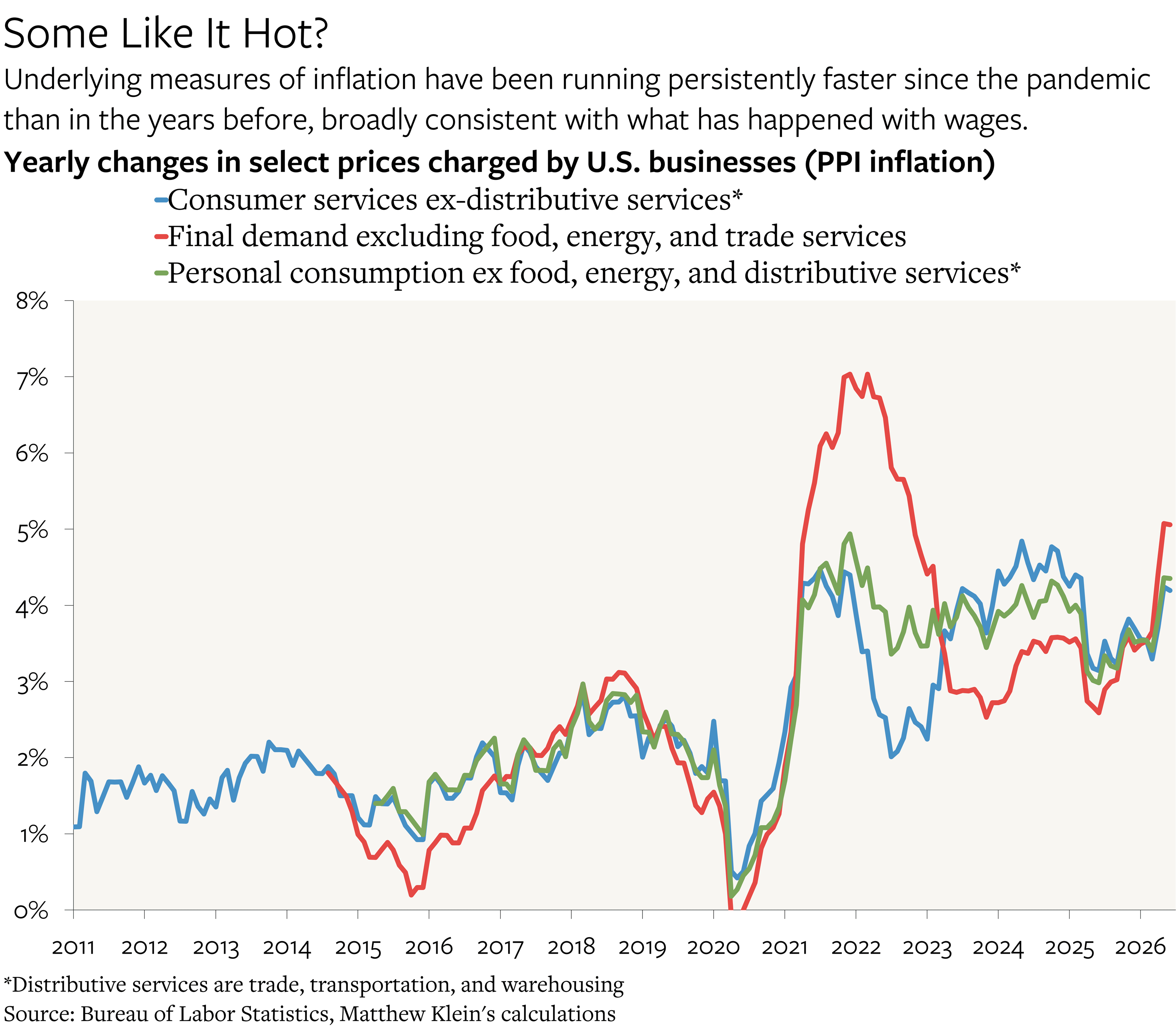
A closer look at the specific categories driving the apparent CPI deceleration, especially alongside the complementary data on producer prices, also suggests that the headline slowdown may be short-lived, especially for the preferred measure of Federal Reserve officials (the PCE price index).