

It is possible that we are on the cusp of a productivity boom.1
As it happens, the last one started almost exactly thirty years ago and ran for about eight years. During that time, the real value of goods and services produced in an average hour of work rose 14% above what would have been expected based on the prior trend (3.6% average yearly growth vs. 1.7% a year). When the boom ended, the old growth rate returned, but the one-off gains in the level of productivity were retained. That persistent improvement in output/hour is massive, and comparable in magnitude to the persistent losses in real incomes associated with the financial crisis.2
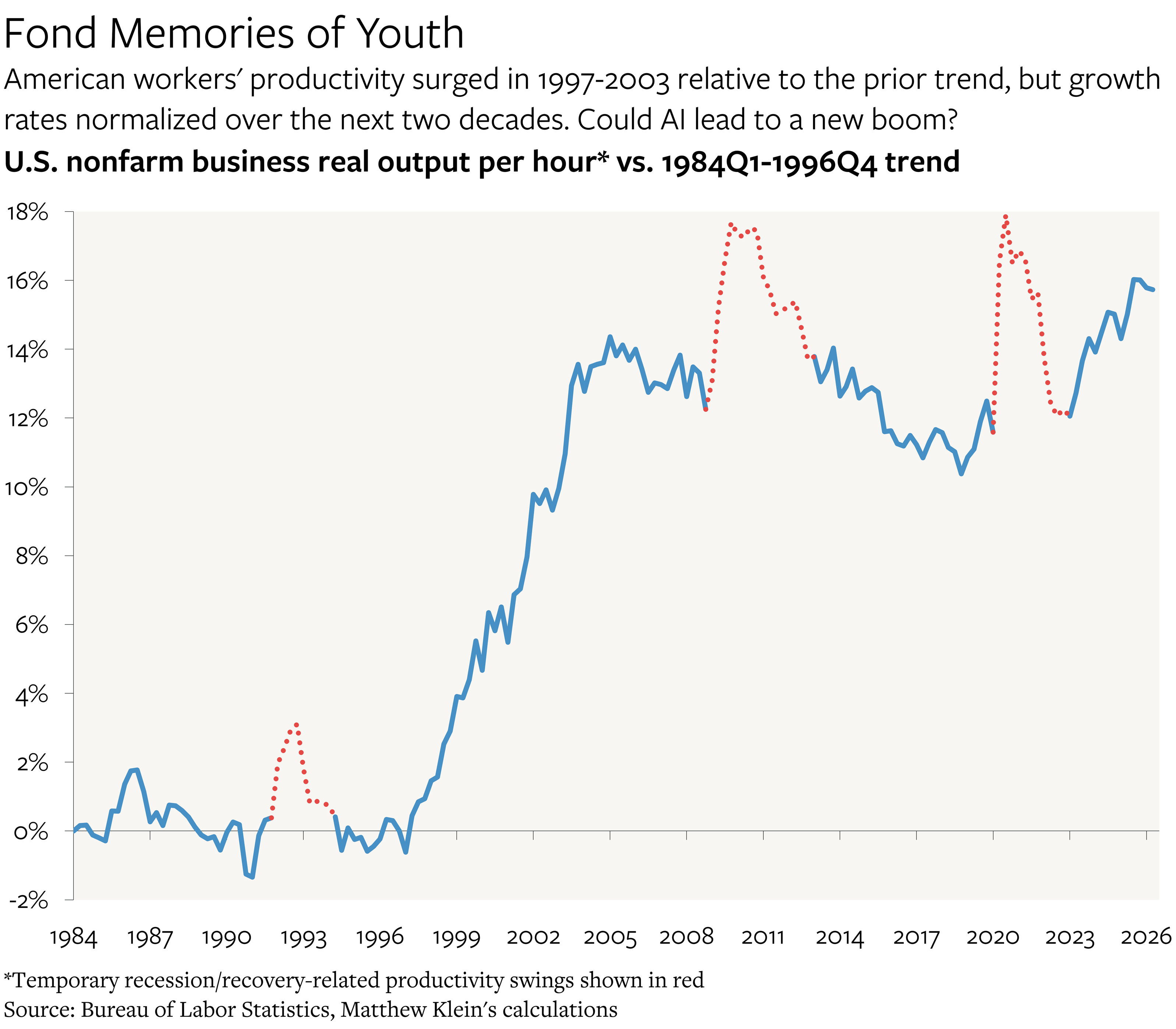
I have no view on the extent to which recent software innovations will boost productivity, although many published estimates imply that the boost could be comparable to what we experienced in the late 1990s and early 2000s. Consistent with this, an investor I respect recently told me that the profit expectations currently embedded in the market pricing of the major companies associated with AI imply an economy-wide productivity acceleration of about 1.5pp/year for the next 5-10 years. (For a wider range of views, it is impossible to beat the Federal Reserve Bank of Dallas’s report from last summer.)
Suppose productivity growth does accelerate to the average pace set during the last boom. One obvious question is: what does that mean for monetary policy?
The standard story is that Alan Greenspan was the hero of the 1990s who prevented the Fed from unnecessarily raising interest rates—opposing, among others, Janet Yellen—and thereby made it possible for more people to find jobs. Supporting business optimism about new technologies via relatively lower interest rates, in this view, led to more investment and more hiring, all without any extra inflation. This narrative is understandably appealing to (some) people currently at the Fed, as well as their allies in the administration. A cynic might wonder if the Fed’s new task force on “productivity and jobs” was created just so that it could be stacked with people who might support this position.
I have two points.
First, nominal interest rates were meaningfully higher in the 1990s than now, even though inflation was meaningfully slower then and fiscal policy was much tighter. Simply re-running the Greenspan playbook would imply a big upward shift in rates from current levels, not cuts.
But there are also good reasons to think that monetary policy in the last productivity boom was too loose, thereby undermining the sustainability of the investment surge and (partially) sowing the seeds for the subsequent housing debt bubble and financial crisis. From this perspective, rates would need to rise even more.
Rates Were Higher In the 1990s
Depending on which measure you prefer, inflation in the years immediately before the 1990s productivity boom was either the same as it has been over the past few years, a bit slower, or a lot slower. Nominal incomes were rising at the same rate then as now. Meanwhile, nominal rates across the yield curve were substantially higher in the 1990s than now. (Until the emerging market debt crises of 1997-8 temporarily pushed rates down, although even then, rates were no lower than today.) So not only were nominal risk-free rates higher in absolute terms, they were much higher relative to economic conditions.
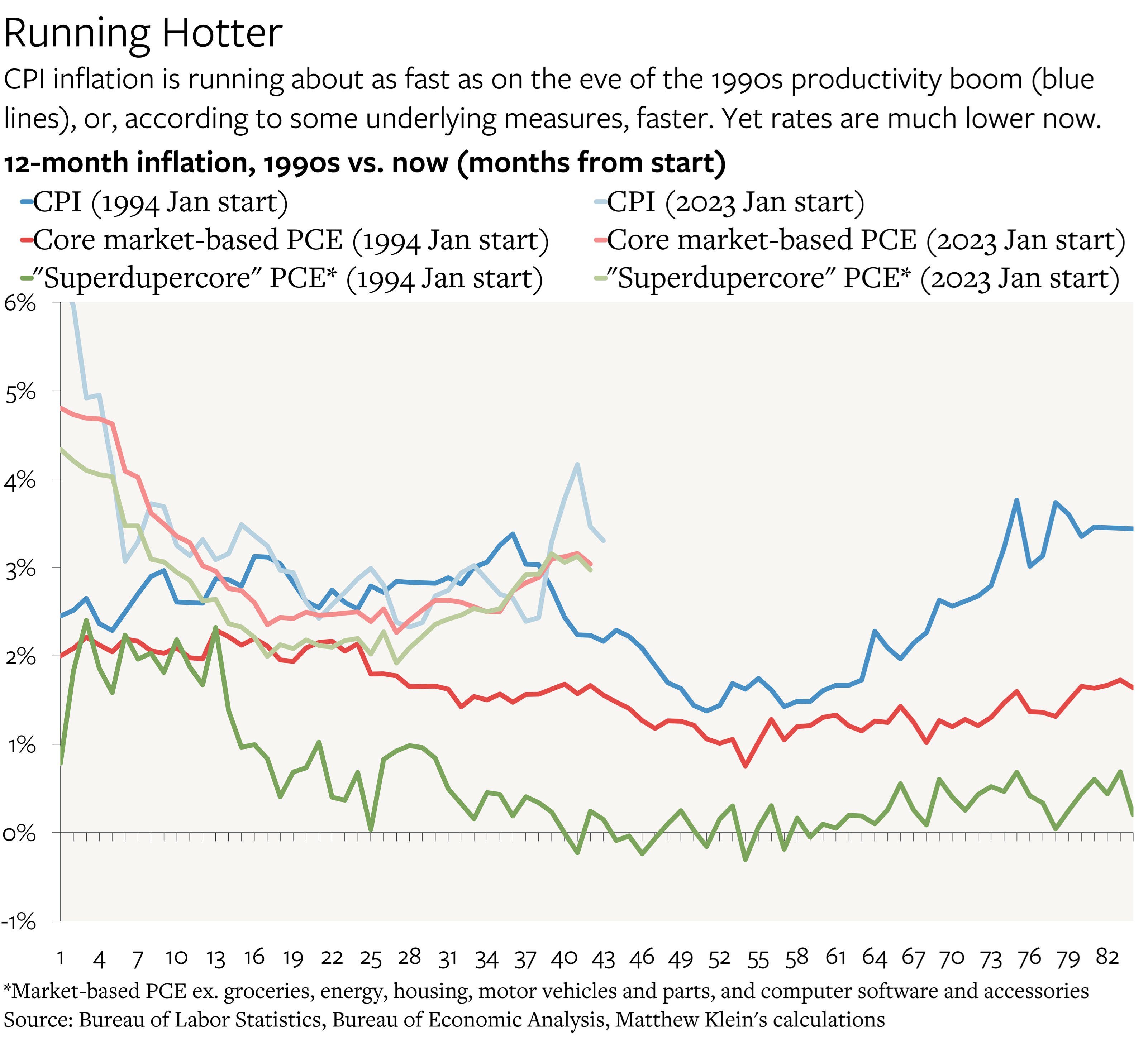
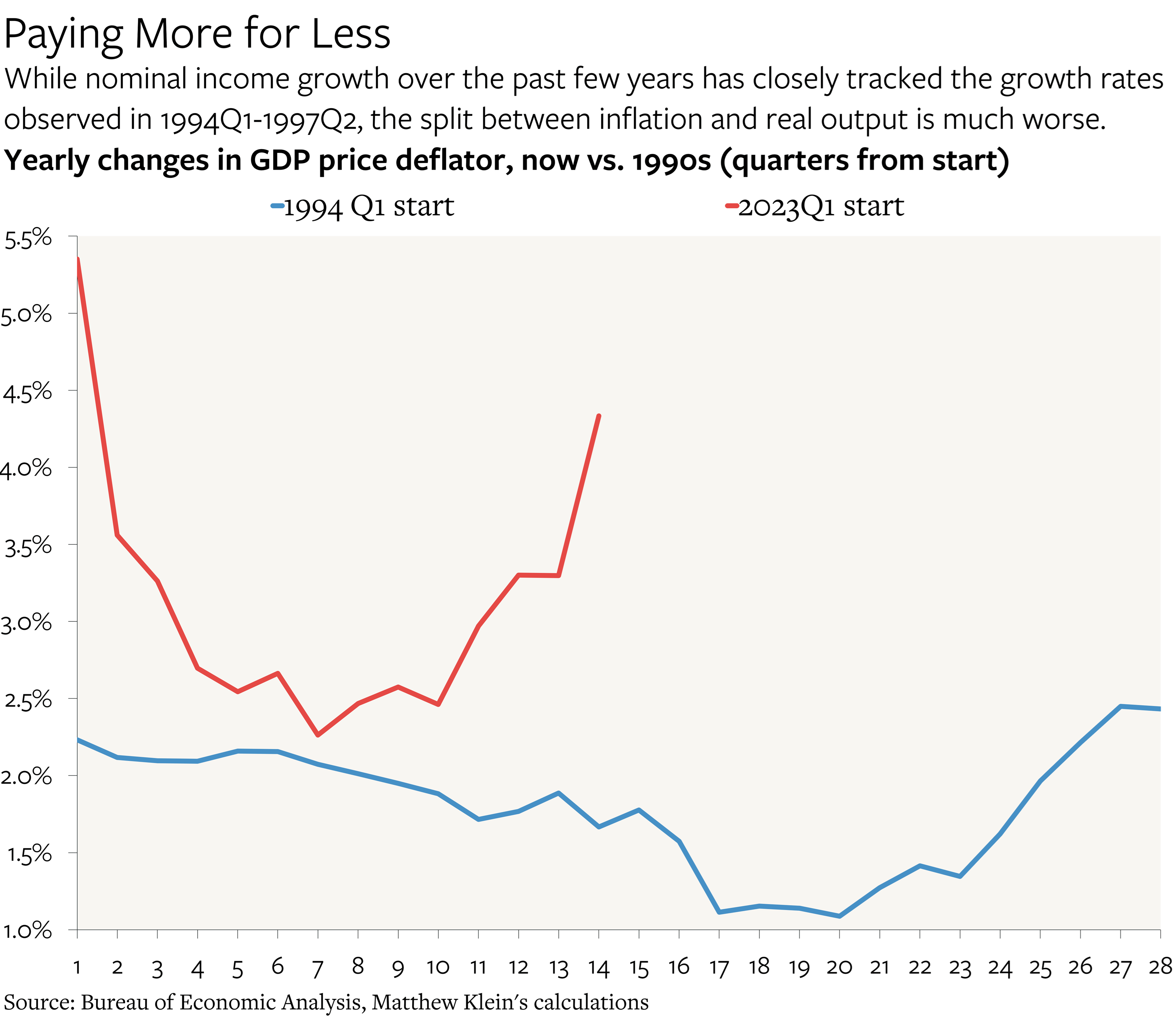
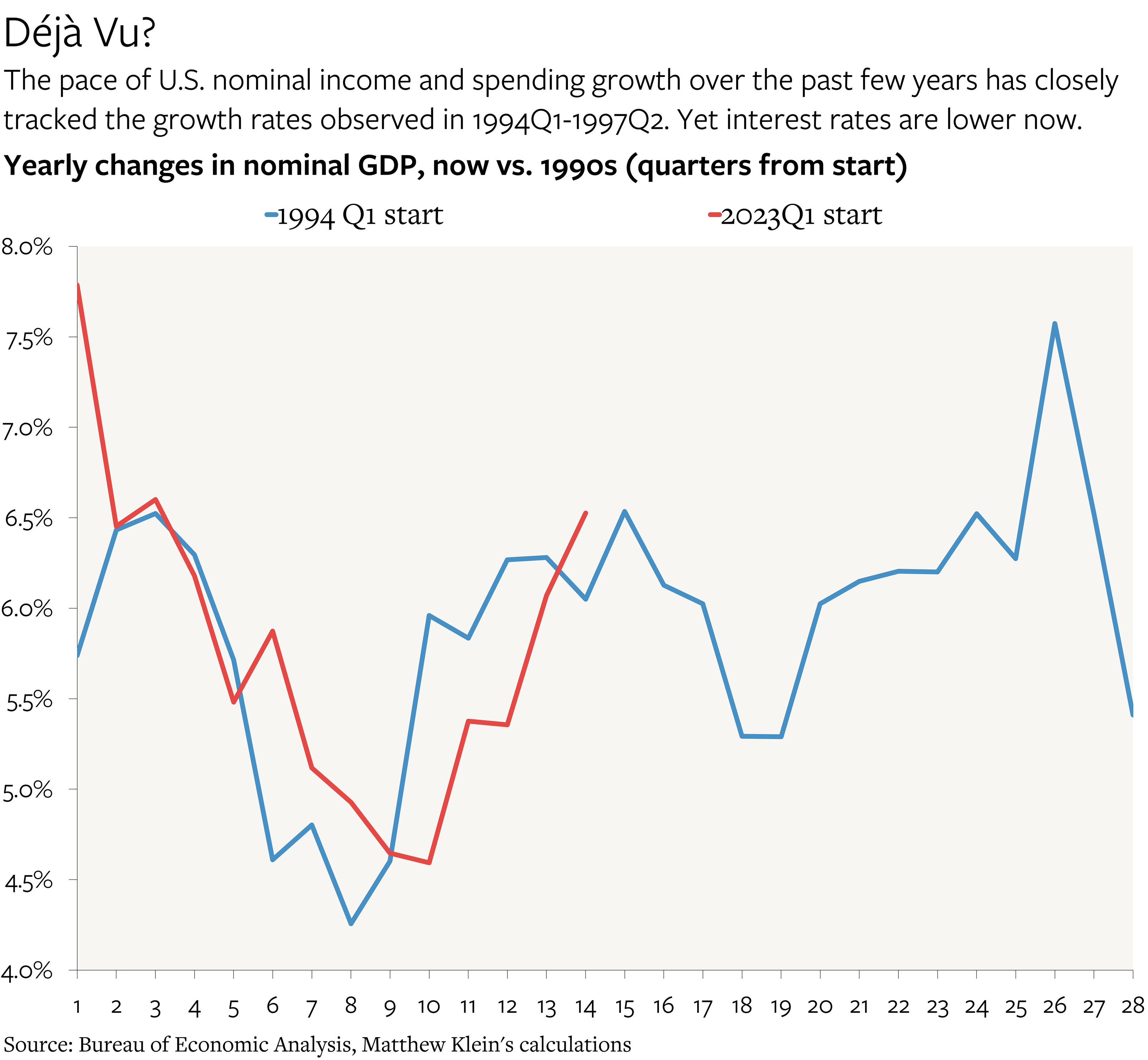
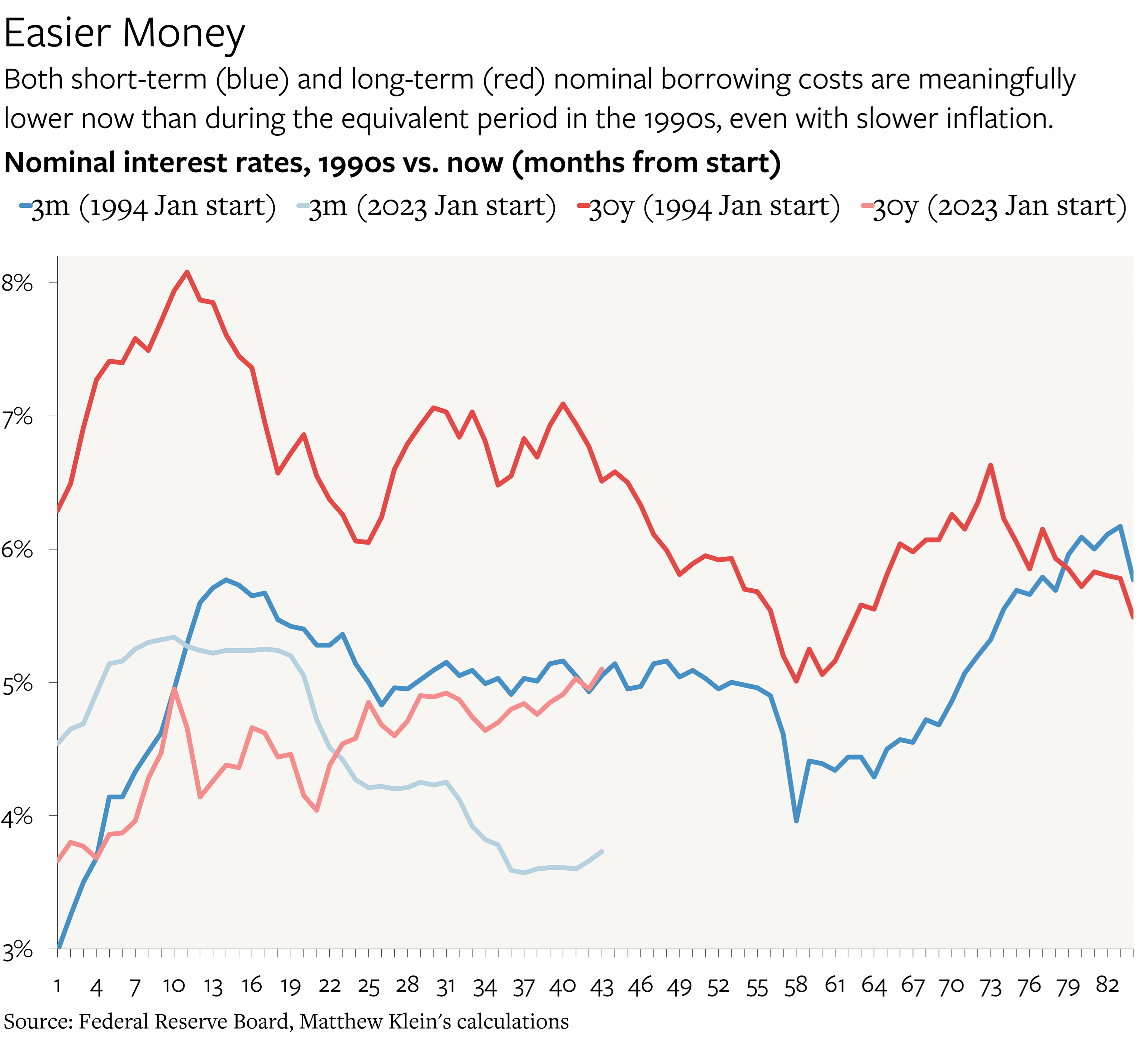
There are many forces that affect the level of where interest rates “should” be at any point in time. The combination of faster inflation now than then, comparable nominal growth, and lower nominal rates does not necessarily prove that rates are currently too low, even if that is the most straightforward interpretation. Interest rates embed expectations about the future while the inflation data describe the past. Depending on how much you think inflation will slow from here, the current levels of nominal interest rates might not appear as egregiously low as they do now.3
Fortunately, we can compare today’s forward-looking inflation-adjusted real interest rates with their levels in the 1990s. That exercise makes two things clear: real rates rose during the last productivity boom, and they did so from a starting point meaningfully higher than today’s levels of real yields.