

The test of whether you are genuinely sorry for a mistake, according to Maimonides, is if, when faced with the same circumstances as the last time you did wrong, you behave differently. “Not because of fear or a lack of strength,” but because you felt so much regret for what you did that you improved your character in response.
Federal Reserve officials may have started this process of atonement. For the past several years, they have repeatedly underestimated both the strength of the U.S. economy and the underlying inflationary trend. Those analytical errors led the central bank to wrongly lower interest rates in September-December 2024, and again in September-December 2025.
On September 16 2026, however, they raised their short-term interest rate target band from 3.5-3.75% to 3.75-4%. Tellingly, Fed boss Kevin Warsh characterized the move as “remov[ing] a dose of accommodation”, rather than a tightening or an increase in “restriction”. While many of his colleagues—most notably Governor Christopher Waller and New York Fed President John Williams—had been claiming that monetary policy was at least somewhat “restrictive” as recently as January, Warsh said that they “were hard-pressed to describe it that way” now.
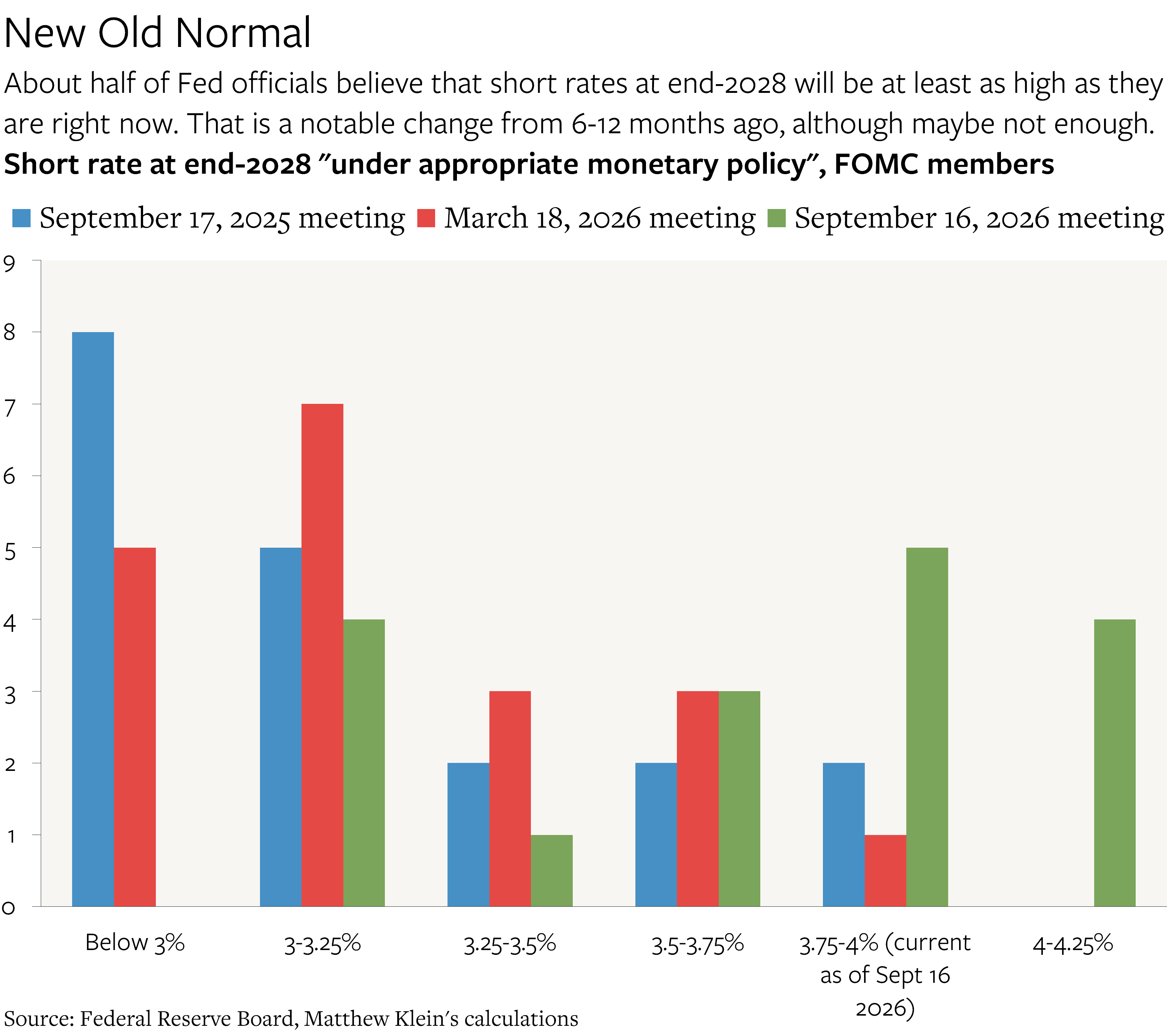
This shift has flowed through to the distribution of what officials believe will constitute “appropriate monetary policy” in the years ahead.
Almost all Fed officials now believe that short-term interest rates at the end of 2027 will be higher than they are now. None believed that as recently as the end of 2025. In fact, most officials back then expected rates to fall substantially from where they were at the time, with the vast majority expecting rates to be 3.25% or lower. (In January of this year I published a note titled "Is the Market Underpricing the Risk of Fed Hikes?" which I feel pretty good about now.) The latest picture of “appropriate” short rates at the end of 2028 also looks notably different from what it was even as recently as March, although it still seems inconsistent with nominal income growth of ~6% a year. But at least things are moving in the right direction.
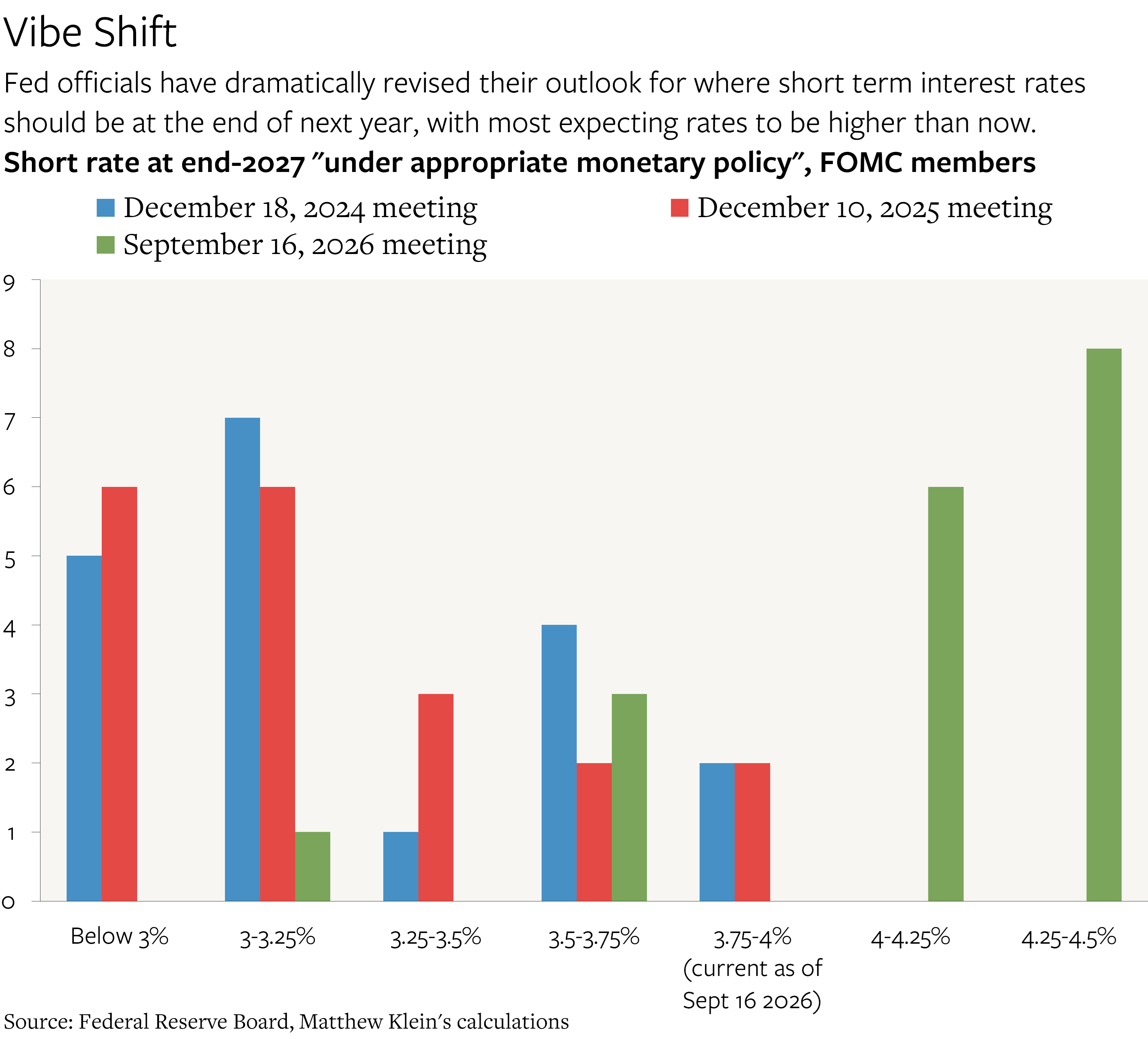
The change in sentiment cannot be explained by the tariffs, which are old news. Economists at the Federal Reserve Board estimated that the impact of tariffs on the price level has been essentially zero since last October, while their colleagues at the St. Louis Fed estimate that tariffs never added more than 0.6 percentage points to y/y core inflation, and only explained 0.4pp of the excess in core inflation as of June. Besides which, tariffs are also somewhat bad for growth and employment insofar as they are taxes that sap disposable income. Nor can Fed officials’ change of heart be explained by the ongoing disruptions to the flow of commodities out of Arabia via Hormuz or Bab el-Mandeb, because the impact on growth should be at least as significant as the (temporary?) impact on inflation.
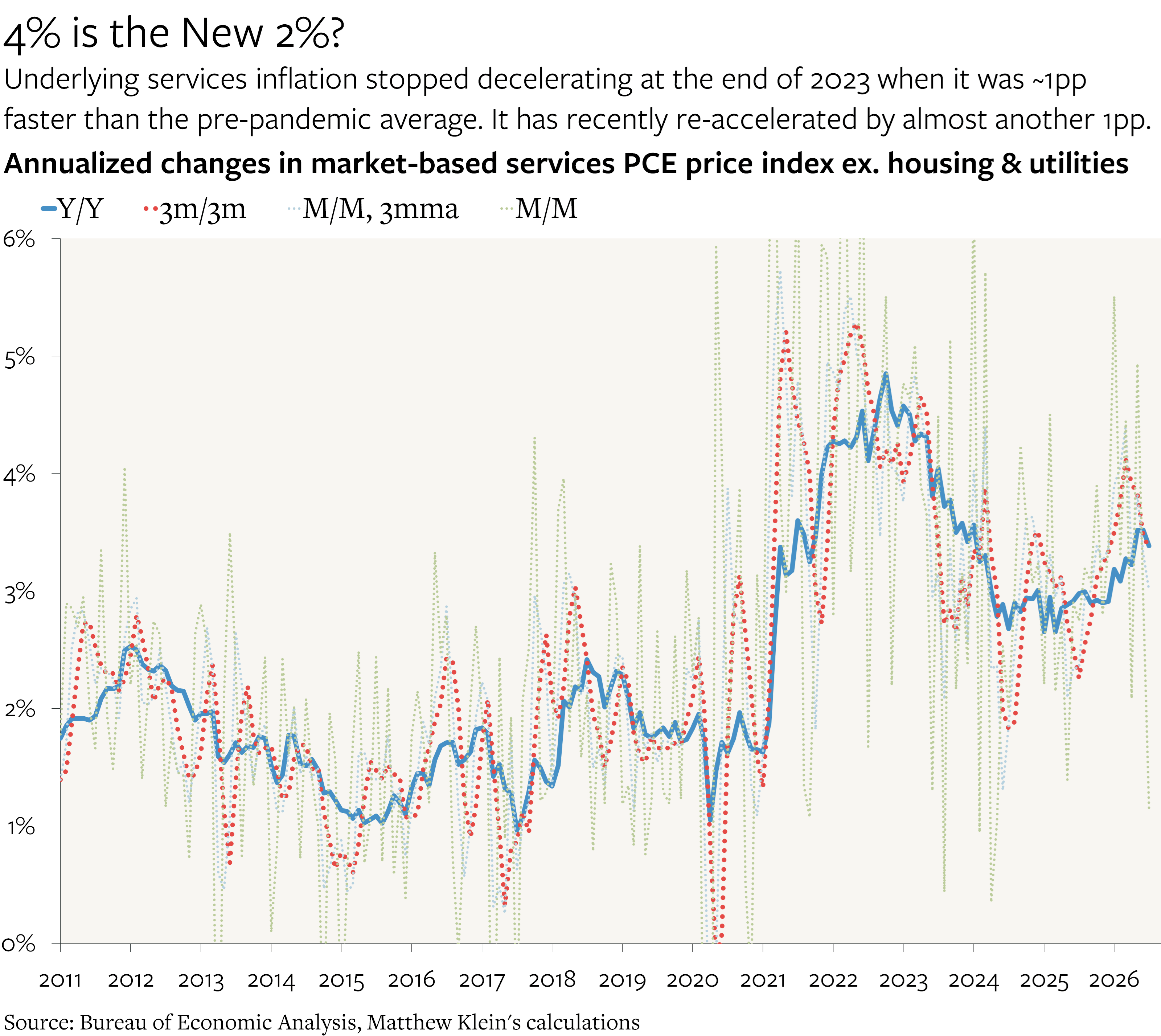
Rather, it seems that at least some Fed officials have belatedly realized that underlying nominal growth continues to run too fast to be consistent with the central bank’s alleged 2% yearly inflation target, and for largely benign reasons. I have been making this point for years, but it is worth reiterating that the prices most sensitive to domestic demand and least exposed to mismeasurement issues or other idiosyncracies have consistently been rising 1-2pp faster than in the years immediately before the pandemic—and were even accelerating in the months before the war with Iran.
Yet from mid-2022 until now, Fed officials seem to have judged that all of the forces responsible for unwelcome inflation—Russia’s war on Ukraine, tariffs, deportations, the war with Iran—also threatened the outlook for jobs. That would explain why their assessment of the risks to the employment mandate and to the price stability mandate tended to move together. If “normal” factors such as consumers’ access to credit or businesses’ appetite to invest were driving things, the perceived risks to the inflation and employment mandates would be uncorrelated, or even move inversely to each other.
That shift has finally happened. In fact, Fed officials are now more bullish on growth and employment—and less concerned about downside risks—than they have been since before the pandemic. The latest data on private sector balance sheets, borrowing, and asset purchases can help explain why.