

Hope is not a strategy. Yet “hope” seems to be the only idea that some Federal Reserve officials have for bringing inflation back to the central bank’s alleged 2% yearly target.
Back in 2024, Fed officials’ tolerance for faster-than-desired inflation could be explained by their misplaced concerns about the health of the job market. In 2025, they were unsure how to respond to the barrage of destructive policies coming from the White House, including the constant threats against Fed officials. So far this year, many Fed officials have chosen to blame excess inflation on the war with Iran, even though the data from before the war contradict that explanation.
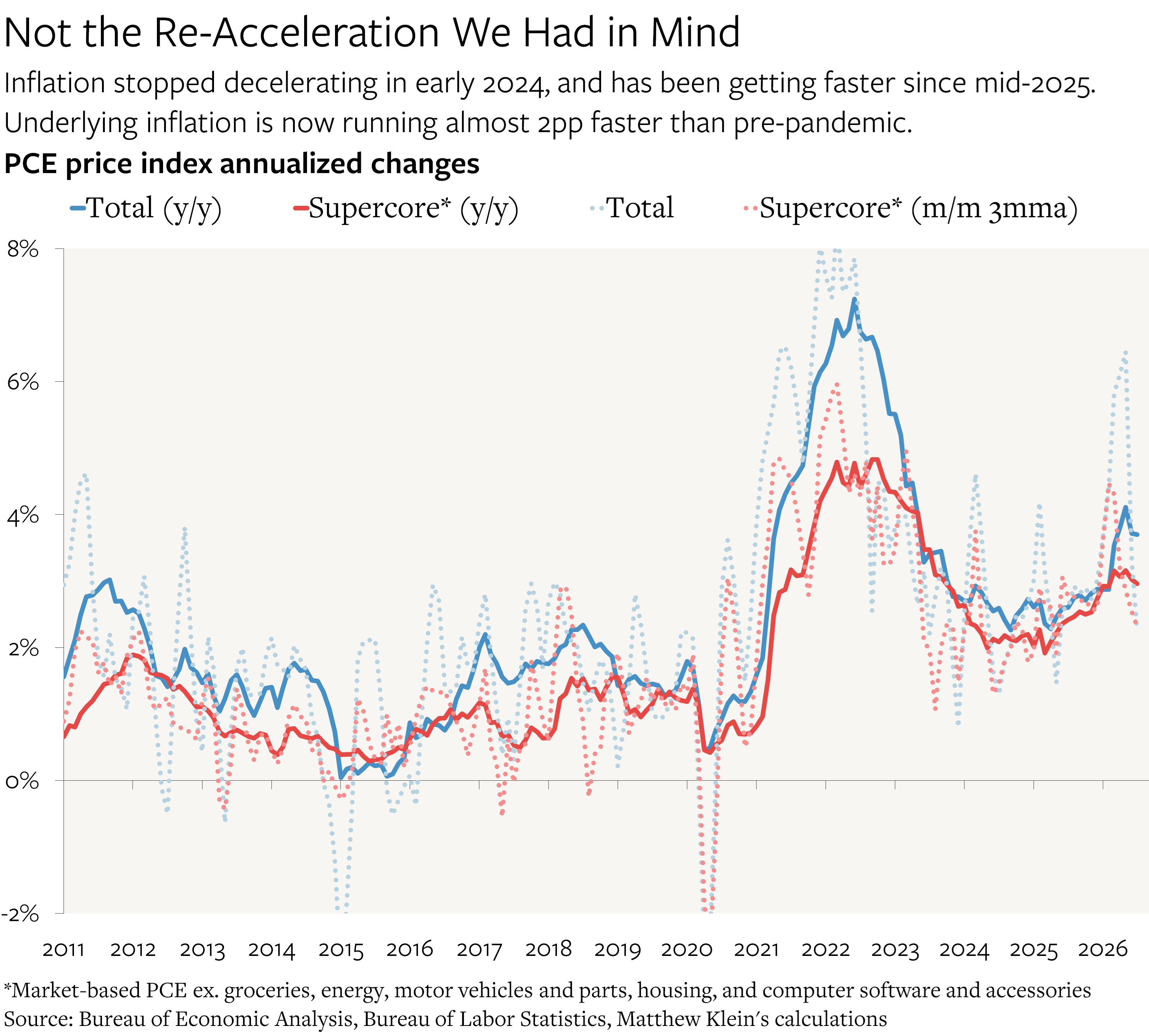
Regardless of the excuses, the observed fact is that inflation has remained faster than what Fed officials expected—and faster than their ostensible target—for years. Contrary to what many officials seem to have believed would happen, inflation stopped decelerating in 2023. This is especially clear when focusing on underlying measures that exclude the most volatile and idiosyncratic components. Even before the unpleasant surprises of 2025-2026, the “supercore”1 version of the Personal Consumption Expenditures (PCE) price index was rising about 1 percentage point faster than in the years immediately preceding the pandemic. Now it is rising about 2pp faster.
Yet hope springs eternal.
One possible explanation comes from senior Fed staffers, who published a retrospective analysis last year on why they had failed to forecast the inflation surge of 2021H2-2022H1.2 Their paper is useful for describing the Fed staff’s process and how it has evolved. It also reveals some questionable choices that may still be contributing to the persistent overoptimism about disinflation.
The rest of this note focuses on the Fed’s forecasting methodology, reviews the distribution of price increases as suggested by Kevin Warsh at Jackson Hole, and provides some updates on the latest numbers on producer and consumer prices.
The Fed’s Underlying Inflation Mistake?
As the Fed staffers explained in their 2025 retrospective, their inflation models were plagued by what they call “specification errors (broadly construed)”. This equation, from their paper, represents how they forecasted inflation before 2020:
In other words, inflation in the immediate future was expected to be some weighted average of current inflation and “inflation’s long-run trend—that is, the rate of inflation that would eventually prevail in the absence of any slack, supply shocks, or idiosyncratic relative price changes”, i.e. π*, plus the gap between the observed unemployment rate and Fed estimates of “neutral” (𝑈-𝑈*), plus the two fudge factors (𝑍 and 𝜖):
changes in relative import and energy prices (“supply shocks,” 𝑍), and temporary innovations 𝜖, including idiosyncratic relative price movements—for example, a change in personal consumption expenditures (PCE) medical services prices following a change in Medicare reimbursement rates or unusual swings in core nonmarket prices.
According to the staff review, their problems did not come from their forecasts of unemployment, import prices, or energy prices. The staff did not perfectly nail their forecasts of those inputs, but they were close enough. Rather, the problem was that their model was not up to the task of explaining what was happening during the pandemic and reopening.