

Yields on longer-term U.S. bonds are now high enough that Treasury Secretary Scott Bessent feels compelled to lecture traders that they are misunderstanding the “fundamentals”. Beyond the patronizing language, he has also increased the Treasury’s buyback program, which will marginally reduce the volume of long bonds (20+ year) in circulation while boosting the supply of bills and/or banks’ deposits held at the Federal Reserve. So far, none of this has worked, and Bessent has since claimed that he was just trying to “let market participants know that things maybe aren’t a one-way trip”. Understandably, partisan hacks and professional debt scolds are both having a grand time, arguing that the markets are reacting to an unsustainable fiscal situation and demanding some form of austerity to bring rates back down.
I have a different view.
As I have been arguing for years, rates are still low relative to reasonable expectations of inflation and growth. Incomes and spending are currently rising about 7% a year in dollar terms. Yes, nominal growth could slow somewhat from that blistering pace, depending in part on what happens with the Strait of Hormuz. But the question is whether growth will slow by enough to make 5% yields on long-term fixed income attractive relative to either interest-bearing cash equivalents, or to riskier assets with uncapped upsides.
Put another way, today’s rates are obviously too high only if inflation and growth are both poised to slow sharply from here. That is certainly possible, but it would (probably) only happen if the U.S. fell into a downturn. Budget tightening can “help” to the extent that tax hikes and government spending cuts sap the purchasing power of households and businesses by enough to crush the economy.1
Absent any austerity program that has yet to be announced, there is so far zero evidence of any looming slowdown in the U.S. data. If anything, the numbers on everything from retail spending to the length of the manufacturing workweek suggest that the economy has been accelerating (slightly) relative to where it was in 2024-25.
Intriguingly, it seems as if Federal Reserve boss Kevin Warsh agrees with this assessment. At the latest Jackson Hole Economic Symposium, he highlighted that profits and business investment are booming, that financial conditions are loose, and that “labor markets are consistent with full employment.” He also noted, as I have, that the latest inflation numbers “do not tell me that underlying trends have meaningfully improved.” What this means for how exactly the Fed will behave is not entirely clear, but the market-implied odds that officials will raise their short-term interest rate target band in September jumped from 35% to 62% right after Warsh’s speech was delivered, while the implied probabilities of additional interest rate increases further ahead also jumped.
To be clear, this is (mostly) good news.
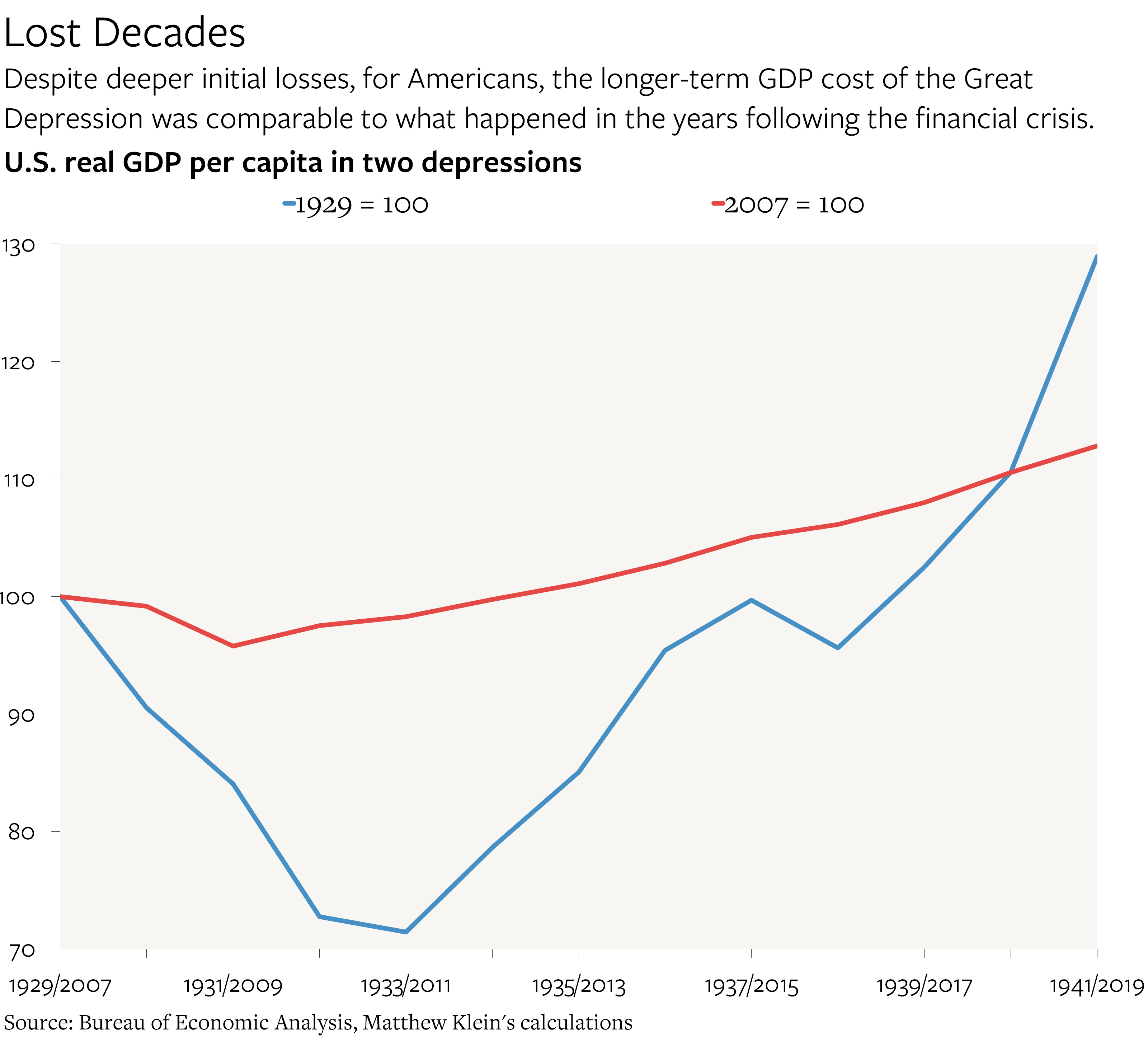
The low rates that too many people had come to view as “normal” were symptoms of deep social pathologies. Real gross domestic product per American rose less between 2007 and 2019 than it did between 1929 and 1941. The Great Depression is typically viewed as having been more severe because the initial downturn was sharper, but the stagnation in living standards following the financial crisis was roughly as bad.
That had implications for interest rates. As Warsh put it in his speech, “it was a widely held view that an excess of capital would sit on the sidelines for a long, long time, because there just wouldn’t be enough compelling investment opportunities.” That “excess” implied low yields. But, as Warsh pointed out, “times sure have changed.” If capital has indeed become scarcer relative to the universe of good investment opportunities, interest rates should be much higher than they were.
Warsh may have been thinking mainly of the recent rush to build data centers and the prospect of faster productivity gains, but, as in the 1940s, the change in the demand for capital was preceded by a reflationary surge in government spending, which reset both consumers’ and businesses’ balance sheets. I have repeatedly argued that pandemic-related income subsidies were economically analogous to WWII military expenditures, which finally pulled the U.S. out of the Great Depression. (In the U.S., the rearmament recovery preceded official entry into the war by about two years.) The result is that both consumer spending and business investment have both become far less sensitive to credit conditions than in the past, which is why economic activity has held up so well in the 4.5 years since the Fed began raising rates.
Meanwhile, the one-time flows of pandemic aid have since been followed by sustained efforts to boost national security across the major economies through investments in rearmament, critical goods production, and new energy infrastructure. And that began before the data center boom created an additional impulse for capital spending.
But unless there are loads of unused workers, machines, and raw materials just lying around, the only way to spend relatively more on essential machinery, equipment, and nonresidential construction is if someone spends relatively less on consumer goods, services, and housing. Higher interest rates can help to the extent that they can discourage those lower-priority activities and/or encourage people in the rest of the world to accept promises of goods and services in the future in exchange for actual goods and services today, although other mechanisms could also work.2 In this context, the current level of interest rates looks downright benign.
In my previous note, I argued that U.S. rates would probably have to rise if we ended up experiencing a productivity acceleration comparable to the 1997-2004 period, which, so far, is not visible in the available data. In the rest of this note I will focus on why the latest numbers imply that nominal income and spending growth are showing few signs of slowing. To save space what follows will be light on text and heavy on charts.